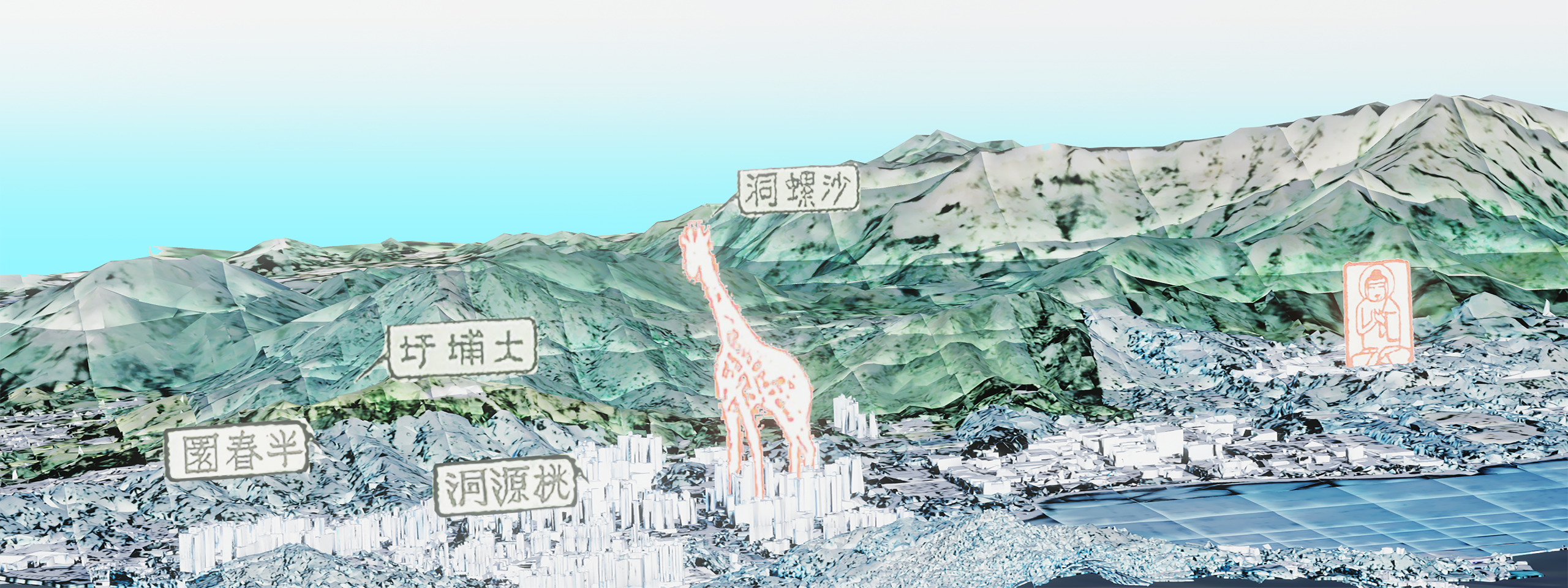

Foreword to “Tai Po Literary Trail──New Territories East Literary Promotion Project”
In the morning, I walked on kapok wadding and faced the wind.
I’ve eaten pork chop noodles from the street market that I’ve been talking about for over 20 years.
Reminiscing about the last days of Jusco after class
Stop at the red van station in Mong Kok
Overlooking the sea and waterfalls
Discovered that Taoyuan Cave has not been a place of escape for a long time
The library is also abandoned
But I can still write poems after the disaster
Whether it is non-concerning details of people’s livelihood or the changes of the times, traces can be found in the words written because of Tai Po. Tai Po is the oldest district in Hong Kong. During the Southern Han Dynasty (917-971), it was famous for the Pearl Mining Field in Dabuhai, Meichuan County. It was not until the establishment of the Jingluo Family School in the Ming Dynasty that cultural and educational activities began. At the end of the 19th century, the British and the Qing government signed a special treaty to expand the boundaries of Hong Kong. After the Six-Day War in the New Territories, Tai Po was included in the territory of Hong Kong. In the image records of Hong Kong over the years, the scenery of Tai Po has always been ranked behind the urban landscape, and has even been absent from literary discussions for a long time. Tai Po was unable to keep up with the construction of Victoria City, but it silently played the important role of “the backside of the city” in the development process of Hong Kong. However, it is not the complicity of the city. Tai Po, with its Taoyuan Cave, has always been the first choice for escape from the world. It has a few but extremely crucial poems and history: Nanshe poet Deng Erya (1884-1954) who lived in seclusion in the green garden, Chen Benzhao and Chen Gun and other teachers and students of Pu Normal University who pioneered the New Territories Normal School, and Wu Baling (1 904-1976), sky novelist Li Wo (1922-2021) who made his debut on Theater Street, and Kun Nan (1935-) who lived in Jinshan to embrace the trend of modernist poetry. They still lead the trend and development of Hong Kong literature and culture, and also provide another choice to describe Hong Kong outside the urban center.
Members of the Center for Chinese Literature and Culture at The Education University of Hong Kong participated in the Hong Kong Literature Walk at the Chinese University of Hong Kong from 2015 to 2016. They participated in a guided tour of Tai Po with literary friends living in the district. During this period, they were exposed to Professor Lu Weiluan’s “Hong Kong Literary Zong: (China) Mainland Writers from the South and Their Cultural Activities” and collected literary resources in Tai Po. Since then, they have considered the possibility of using Tai Po to describe Hong Kong literature. In 2017, Dr. Yang Yingxian, a former member of the center, put his idea into practice and applied for fund funding in the form of a journal/book, but unfortunately it failed. During the period, there were personnel changes, and the center was busy preparing for the “Compendium of Hong Kong Literature” and “Remembering Our City: Hong Kong Literary Years Special Exhibition”. By the end of 2020, the idea was proposed to Tai Po District Councilors again, and finally the “Tai Po Literary Trail─New Territories East Literature Promotion Project” was promoted by the Tai Po District Office from 2021 to 2022.
The results of this project will be compiled into a book and promoted to the public through various exhibitions and guided tours, hoping to contribute academic expertise to community cultural and educational development. It aims to discover important Hong Kong literary and artistic works of different periods and types, revisit important community writers or literati who have been ignored, reshape regional historical legends and folk tales, re-explore cultural attractions and historical sites, sort out the development of literature and culture in Tai Po, promote the concept of Tai Po literature, and promote community culture and tourism. The most important thing is to preserve Tai Po’s literary works over the years so that they will not be forgotten and lost. Research Centre for Chinese Literature & Literary Culture will continue to realize various possibilities under the concept of “Tai Po Literature”.
The public is welcome to contact the Center at any time if they have any inquiries or comments about the project, or if they have cultural relics or information to provide. (available via Facebook message, email rccllc@eduhk.hk, or call 29486554 for enquiries)
Tai Po Literary Trail Team Research Centre for Chinese Literature & Literary Culture
Met on September 23, 2022
Revised February 5, 2023
This project is funded by the Community Engagement Program of the Home Affairs Department
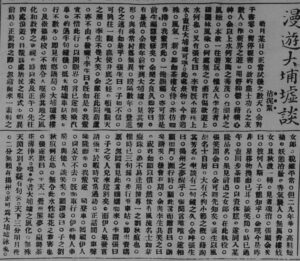
Data organization
The plan is to conduct a comprehensive excavation and research on Tai Po’s literary and cultural materials from the 19th century to the present, such as newspapers, periodicals, Mongolian books, topographies, etc. After sorting and analyzing and clarifying the copyright status, the content will be displayed to the outside world in the form of a database.
The current ways of collecting data include: 1. Excavating and digitizing Tai Po art and literature documents through university library collections and the assistance of collectors; 2. Refining them from the center’s existing projects; 3. Collecting online resources.
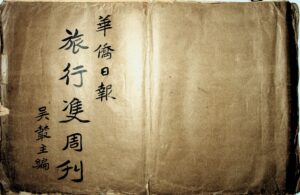
“Hong Kong Literature in Tai Po” Exhibition
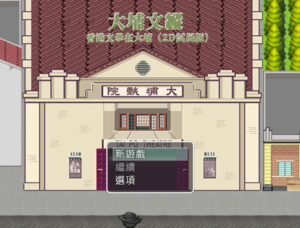
This project will bring Tai Po’s artistic and cultural achievements to different corners through permanent virtual exhibitions and irregular physical exhibitions. The permanent exhibition space will aim to recreate the “Tai Po Theatre” which was the cultural center of Tai Po in the past. (Today’s Ming Yue House, No. 3 Theater Street, Tai Po)
Click on the picture below or the menu on the left to browse the 2D trial exhibition of “Hong Kong Literature in Tai Po”
literary walks
In preparation for exhibitions and community tours, Tai Po Literary Trail actively prepares tour guide workshops and trains tour guides. The first workshop was held from February to March 2023, and a total of 14 students obtained certificates.
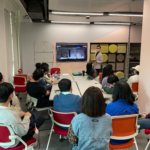
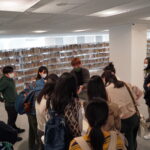
Tai Po Literary Trail pre-guided tours were just held on May 24th and 27th, led by Dr. YIP Cheuk Wai, Director of the Center. Participants included Tai Po civil affairs commissioners, writers, district committee members, district councilors, primary and secondary school principals, and secondary school students, a total of more than 50 people. Among them, Ms. Chen Qiaomin, the Civil Affairs Commissioner, took time out of her tight schedule to attend the event. She did not have time to change into travel clothes and complete the whole process. She enjoyed the whole process with everyone, which deeply impressed the planning team and was sincerely admired. We would like to thank the Home Affairs Department for the sponsorship of the Community Involvement Program and the Tai Po District Office for their support.
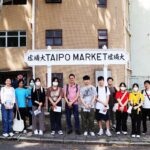
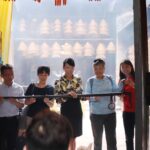
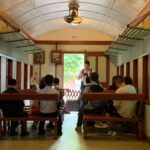
By 2024, this project plans to arrange 24 to 30 literary guided tours, in conjunction with the community writing courses offered by the Department of Literature and Cultural Studies of the Education University, and to invite secondary schools in Tai Po and even Hong Kong to participate in guided tours. In addition to inviting scholars, cultural workers and senior writers to serve as tour guides, and recruiting university students to serve as tour guides, there are also plans to invite Tai Po residents to serve as tour guides. If an organization or school intends to organize a guided tour, or if the public or local residents intend to serve as tour guides, please click here Sign up, or leave your preference.
“Tai Po Literary Trail” Volume 1 and 2
The title of this book is inspired by “Hong Kong Literary Zong: Mainland Writers Coming to South China and Their Cultural Activities” edited by Professor Lu Wei-luan. It is divided into two volumes.
The first volume takes the 1960s as the boundary and collects relevant Tai Po literature and art research papers, compiles and selects local literary works (novels, poems, essays, travel notes, reportage, visual arts works, etc.) and writers’ writings in the region, and examines a number of lost and doubtful art and cultural attractions, such as the Tai Po Market Library, the Green Garden where Deng Erya kept his piano, and the reconstruction of the Tai Po Theater. The more important authors of this period include Deng Erya, Wu Baling, Chen Gun, Yi Junzuo, Kun Nan and other writers.
The second volume is mainly about content from the 1960s onwards. In addition to continuing to include literary works related to the district, it will also include highlights of guided tours and collections of works. In addition, it will also include oral interviews with writers who have lived in Tai Po for a long time.